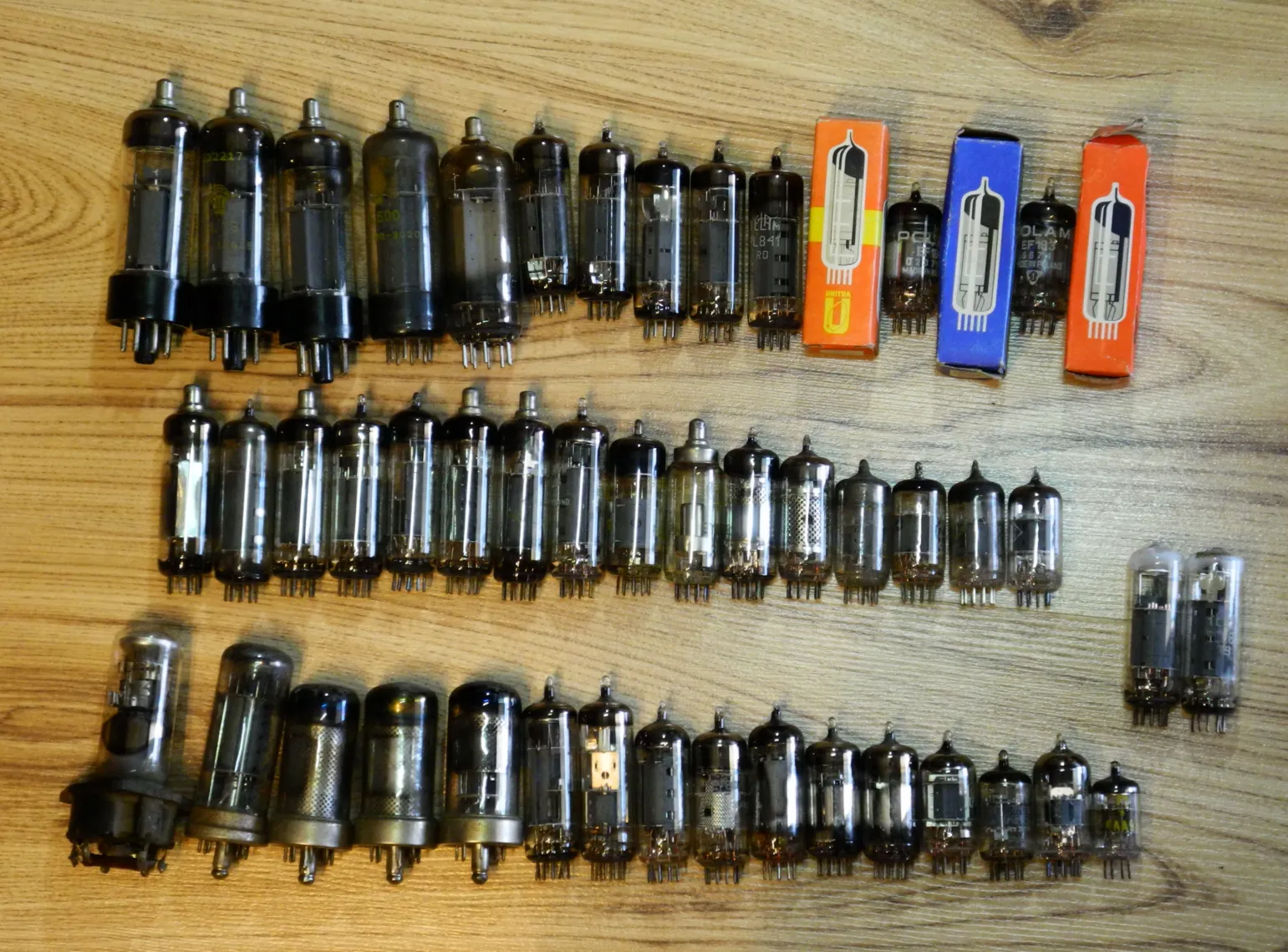
i bought them for cheap. i actually tried to buy 67 vacuum tubes for a lesser price per tube (it was also from just one seller, instead of two), but they flaked out. my main driving force for the purchases was the fact that i've never used or even seen a vacuum tube in real life, save for crt's (and vfd's if you squint your eyes hard enough), so i might as well buy a lot to have some to play with.
since i wanted to learn more about what i had on hands, and also because decided to make this little article, i searched for information on every tube i had, downloaded datasheets, read about them and the manufacturers. i have tubes reaching from the German Democratic Republic and the Polish People's Republic all the way to Japan! the most interesting part was the history of local factories, which there apparently were a lot of, just as many as confusing merges of the companies. this was honestly a really interesting topic, and i'll drop a few cool links later.
the data
from the 42 tubes, two were DOA, thanks to one of the sellers' careless packaging. someone really though that throwing a bunch of glass bulbs into a box and letting them rattle around in vans while travelling half the country is going to end well. awesome. there's another one which just looks dead with a bad case of dead.
i made a small datasheet in plaintext and parsed the details. please note that some of these are guesses, as for example i had a few identical diodes, of which some were missing their markings — i just derived the details for the unmarked from those i'd seen before, since they had the same internal structure. you might also notice that the numbers might not add up for different categories. that's possible because some datum, like the manufacturer's name, might be missing for some tubes due to erased markings.
enough rambling, here's the meat:
the most popular tube is the «?», which i have the most of (5 (five))! these are the ones i couldn't figure out. the actual most popular model in my collection is the py-81 – i have four, which is a booster diode for time base circuits in televisors. all of these were made by Telam/Polam.
the most interesting, to me, tube is the EM-4, again from Polam. i think this note, left in my little textfile after discovering the details, might describe the specimen pretty well: «FUCKING MAGIC EYE TUBE RAAAHAHAHAHHHHHAHAHAH». i really wasn't expecting this one! i loved seeing these goobers on video, and i hope to fire this one up soon.
i have tubes from (at least) five countries.
- 1 from the GB's Haltron
- 1 from Japan's Matsushita (today's Panasonic)
- 1 probably from some USSR fraction
- 4 from Czechoslovakia's Tesla
- 7 from East Germany. this one was very confusing. there were lots of different logos, but ultimately all (?) were related to Rundfunk- und Fernmelde-Technik
- 25 from Communist Poland's Telam/Polam/Polamp/ZWLE (Zakłady Wytwórcze Lamp Elektrycznych im. Róży Luksemburg)
the four different "brands" of Polish vacuum tubes were really a big amalgamate that has a convoluted history, which i'm myself confused about, so the following might be a bit incoherent. they produced mercury, electron, and other kinds of electric lamps across various points in the country. the ZWLE were built by Philips pre-WW2, and produced tubes until all the machines got stolen by Germans and the buildings thrashed. after the second world war ended, a deal was signed with... Philips, who provided the machines and restarted production. i'm assuming that all of my lamps are newer, from the communist era. there was a manufacturer that i couldn't find info on: as described in my doc, sh — sh logo, h in the middle of an s — if anyone knows anything, write a comment.
the most popular "family" of my collection is the pentode or the triode pentode, both of which i have 11. others i own: diode, double triode, double diode pentode, triode heptode, double diode, magic eye. most of these are specialized pairs for use in specific tv/radio circuits like time base circuits, IF/RF amps, audio amps, frequency changers and others.
what now?
i don't know.
an audio amp or distortion effect pedal for my still-unfinished electric guitar sounds like a good project. i wouldn't mind making a small linear power supply with some of the diodes. winding a cool transformer does sound fun: with a filament winding and another tapped winding for the rectification, at least that's how i imagine the circuit. another thing i definitely need to do is try firing up that tuning indicator eye. these are really beautiful and i NEED to see it myself. testing the other tubes is probably a good idea too, xD